
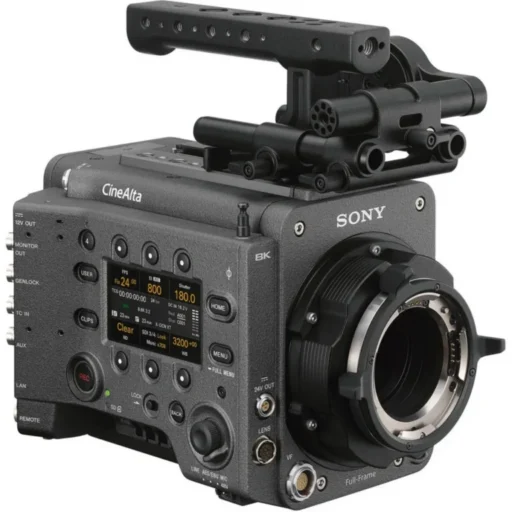

With TakeOne Broadcast Solutions now an authorized Sony Cinema Line dealer — and the sole Sony cinema provider in the Southeast — we’re kicking off a series of technical introductions to the systems we now carry. First up: the VENICE 2, Sony’s flagship full-frame digital cinema camera. This is a working cinematographer’s overview of what’s inside the body, what changed from VENICE 1, and where the camera fits in a modern production pipeline.
Sensor Architecture
VENICE 2 ships in two sensor-block flavors: an 8.6K full-frame CMOS (8640 × 5760, roughly 36 × 24 mm) and the original 6K full-frame block from VENICE 1 (6048 × 4032). Because Sony retained the swappable sensor-block architecture, a single body covers both formats — useful for productions standardizing on a 6K codec pipeline that don’t want to retire VENICE 1 media workflows.
Both blocks carry dual base ISO: 800 and 3200. The high base is genuinely usable, not a marketing checkbox — noise behavior at 3200 in S-Log3 is comparable to the 800 base, which matters for low-light interiors, available-light night exteriors, and any scenario where you’d historically have pushed in post. Sony specifies 16+ stops of dynamic range; in practical exposure terms expect roughly 8 stops over middle gray and 8 below before highlight rolloff goes ugly.
Lens mount is native E-mount with a locking PL adapter included. The PL adapter passes Cooke /i and ZEISS eXtended metadata through to the recording — relevant if you’re committing to a metadata-driven post pipeline (VFX, virtual production, ACES-managed grade).
X-OCN Recording: ST, LT, XT
The headline feature is internal X-OCN recording — no external Codex needed, unlike VENICE 1’s original configuration. X-OCN (eXtended tonal range Original Camera Negative) is a 16-bit linear scene-referred format that preserves the full sensor output with substantially smaller files than uncompressed RAW. It comes in three flavors:
- X-OCN XT — highest quality, largest files. Use for premium episodic, feature, anything graded heavily or destined for HDR finishing.
- X-OCN ST — the sweet spot. Roughly 70% of XT’s bitrate with imperceptible quality loss for normal grades. Default for most jobs.
- X-OCN LT — about half the bitrate of ST. Use for long-form documentary, multi-cam unscripted, anything storage-constrained. Holds up to a modest grade; not the choice for HDR-heavy VFX plates.
VENICE 2 also records ProRes 4444 and 422 internally for fast-turnaround work where editorial wants to skip transcoding. Both X-OCN and ProRes write to AXS-A1TS66 or AXS-A512S48 cards in the camera’s dual slots — simultaneous record to both is supported for on-set redundancy, or one slot can hold a lower-bitrate proxy.
Color Science and ACES
VENICE 2 uses Sony’s third-generation color: S-Gamut3 and S-Gamut3.Cine with S-Log3 as the standard log encoding. S-Gamut3 is the wider primary gamut (use it when you’ll grade in an ACES or WCG pipeline); S-Gamut3.Cine is a slightly tighter set tuned to map cleanly into a P3-D65 or Rec.709 grade with less primary correction.
ACES integration is straightforward — Sony ships an official IDT for VENICE 2, and the camera writes ACES-compatible metadata at the file level. If you’re building an ACES 1.3 pipeline (and most large-format productions are at this point), VENICE 2 slots in without color management headaches. On-set LUT loading is via 1D + 3D LUTs over SDI; the camera handles up to 16 user 3D LUTs in storage.
Built-in 8-Stage ND and Operational Workflow
The internal mechanical ND is one of the most under-rated features for working operators: 8 stages from 0.3 to 2.4 (roughly 1 to 8 stops), glass-quality, no IR contamination at the deep settings. For exteriors and any scenario where you’d previously be swapping screw-in filters or carrying a matte box solely for ND, the internal stage saves real setup time. The clear position is genuinely clear — no offset to dial out.
Frame rate flexibility is broad but worth knowing in advance: up to 120 fps in 4K 17:9, 110 fps in full-frame 4K, and 60 fps at full 8.6K. Anamorphic shooters: VENICE 2 supports 1.3x, 1.5x, 1.8x, and 2.0x de-squeeze in monitoring with the squeezed metadata preserved in the X-OCN file, so on-set framing is honest and post can re-extract any framing.
Production Fit and Positioning
VENICE 2 is positioned for feature film, premium episodic, large-format commercial, and high-end music video. Compared to BURANO, VENICE 2 trades portability and internal autofocus for the higher resolution 8.6K block, the swappable-sensor architecture, ProRes 4444, and the operational refinements (separable extension system, full-size viewfinder ecosystem) that scripted productions expect. Against the FX9 and FX6, VENICE 2 is a different tier entirely — those cameras live in documentary, corporate, and broadcast acquisition; VENICE 2 is meant to anchor a cinema package.
One often-overlooked deployment pattern: VENICE 2 paired with the FR7 PTZ (which shares E-mount and similar color response) for crew-light multi-cam setups where the FR7 covers locked-off coverage and VENICE 2 handles the principal angle. The grade between the two is closer than any historic cinema-camera + PTZ combination has been.
Post Workflow
The standard X-OCN post path runs through Sony Catalyst Browse / Catalyst Prepare for offload, verification, and transcode, or directly into DaVinci Resolve (native X-OCN decode since Resolve 17). RAW Viewer is the free Sony tool for on-set / DIT review with full metadata. ACES projects in Resolve are a one-click IDT assignment.
For productions running Avid editorial, the ProRes 422 proxy slot lets you cut against camera-original ProRes without an intermediate transcode — Sony’s metadata model carries through the AMA / DNX import. Premiere users get native X-OCN decode without third-party plugins.
Talk to TakeOne about the VENICE 2
As an authorized Sony Cinema Line dealer for the Southeast, TakeOne can quote VENICE 2 bodies, sensor blocks, AXS media, and the full accessory ecosystem — and just as importantly, help you spec the camera into a production package that actually fits the job. If you’re evaluating VENICE 2 against BURANO, planning a multi-camera package, or building out a rental fleet, we’d rather talk first than send a quote and hope.