
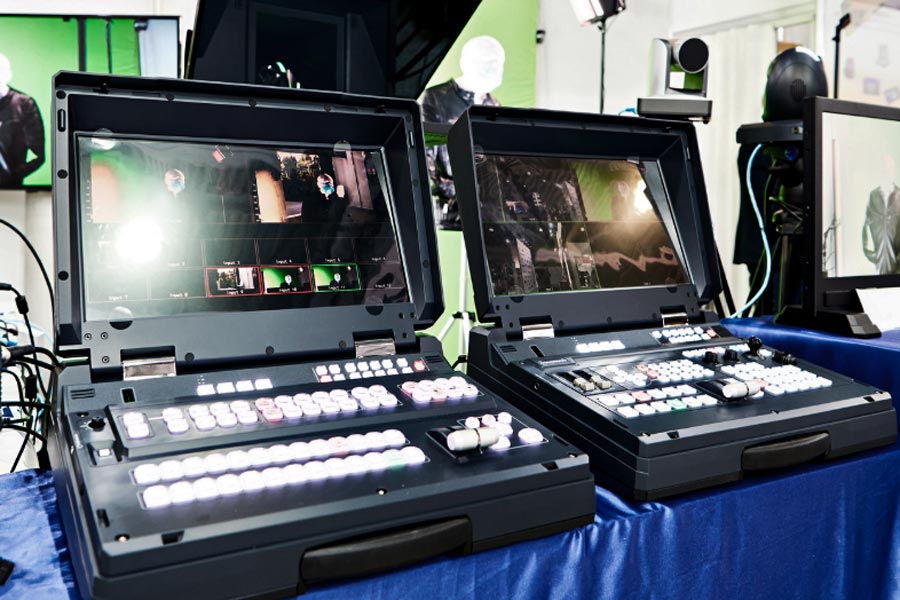

The production control room that fits in a road case and sets up in minutes.
A flypack is a self-contained broadcast production system built into one or more road-ready cases. It contains the same core components as a permanent control room — video switcher, audio processing, monitoring, communication, and routing — but in a portable format that can be rolled into any venue and set up quickly.
Flypacks have become essential tools for organizations that produce live events at multiple locations. Instead of rebuilding a temporary production setup for every show, teams standardize on a proven platform that delivers consistent results regardless of the venue.
How Flypacks Work
At their simplest, a flypack is a pre-racked equipment package in a protective road case. The equipment is permanently mounted on rack rails inside the case. Cables are pre-dressed and labeled. A monitor is often built into the case lid for multiview display. The operator opens the case, connects inputs and outputs, and is ready to produce.
More complex flypack systems span multiple cases. One case handles switching and routing. Another handles audio. A third holds replay and graphics. These multi-case systems rival the capability of a full permanent control room but can be shipped anywhere and set up in hours rather than days.
When to Use a Flypack
- Multi-venue sports production: A conference or athletic program that produces games at 10 different venues does not need a permanent control room at each location. A flypack travels with the crew and delivers the same production quality at every stadium.
- Touring events: Concerts, corporate roadshows, and conferences that move from city to city need production infrastructure that travels. Flypacks are designed for exactly this.
- Backup and overflow: A permanent control room handles normal operations. A flypack provides backup capability or handles overflow when the venue hosts a larger event than usual.
- Church satellite campuses: A main campus has a full production room. Satellite campuses receive the livestream but also need local production capability for announcements, worship, and special events. A flypack gives each campus a turnkey production system.
- Remote and field production: Any location where a permanent control room does not exist but professional production is required. Outdoor venues, temporary event spaces, and remote broadcast locations all benefit from flypack systems.
Flypack vs. Broadcast Truck
Both flypacks and broadcast trucks provide mobile production capability but they serve different needs.
A broadcast truck is a dedicated vehicle with a built-in control room. It drives to the venue and the crew walks into a ready-made production environment. Trucks are ideal for organizations that produce a high volume of remote events and need the full capability of a permanent control room on wheels.
A flypack ships inside the venue and sets up in a room, tent, or any available space. It is lighter, less expensive, and more flexible than a truck. It does not require a parking space, a generator, or a driver. But it takes more setup time and requires a suitable space at the venue.
The decision between a flypack and a truck usually comes down to volume. If you produce 50+ remote events per year a truck may make sense. For 10-30 events per year a flypack is typically more cost-effective and more versatile.
What to Look for in a Flypack
- Build quality: Road cases take a beating. Look for reinforced corners, proper foam inserts, and locking latches. The case is protecting tens of thousands of dollars in equipment.
- Standardized platform: The value of a flypack increases when you can duplicate it. If you need three identical systems for three crews, the flypack should be designed for repeatable manufacturing.
- Setup speed: The whole point is fast deployment. A well-designed flypack should go from case to live production in under 30 minutes. A system that takes two hours to set up has lost most of its advantage over a temporary build.
- Cable management: Cables inside the case should be pre-dressed and secured. External connections should be clearly labeled with matching labels on your venue cable kits.
- Integrated monitoring: A multiview monitor built into the case lid means one less piece of equipment to carry and set up.
Budget Ranges
Flypack costs vary widely based on capability:
- Basic single-case system (switcher, encoder, monitoring): $8,000–$25,000
- Mid-range multi-case system (switcher, audio, replay, graphics): $30,000–$80,000
- Full-capability multi-case production system: $80,000–$200,000+
These numbers include the equipment and the case build. They do not include cameras, lenses, tripods, or other field equipment that lives outside the flypack.
Need a Portable Production Solution?
TakeOne designs and builds custom flypack systems for sports venues, churches, universities, and corporate production teams. Our 5-Minute FlyPack Gen 2 is a compact road-ready platform that can be customized to your exact workflow.
Or call us to discuss your portable production needs.
About TakeOne Broadcast Solutions
TakeOne is a full-service broadcast video integrator and consultant that designs, builds, and supports professional video systems for sports venues, universities, churches, and broadcast facilities nationwide. From control room design through equipment integration and operator training, we handle every phase of the project.
Request a control room assessment or call 1-877-818-2531 to discuss your project.