
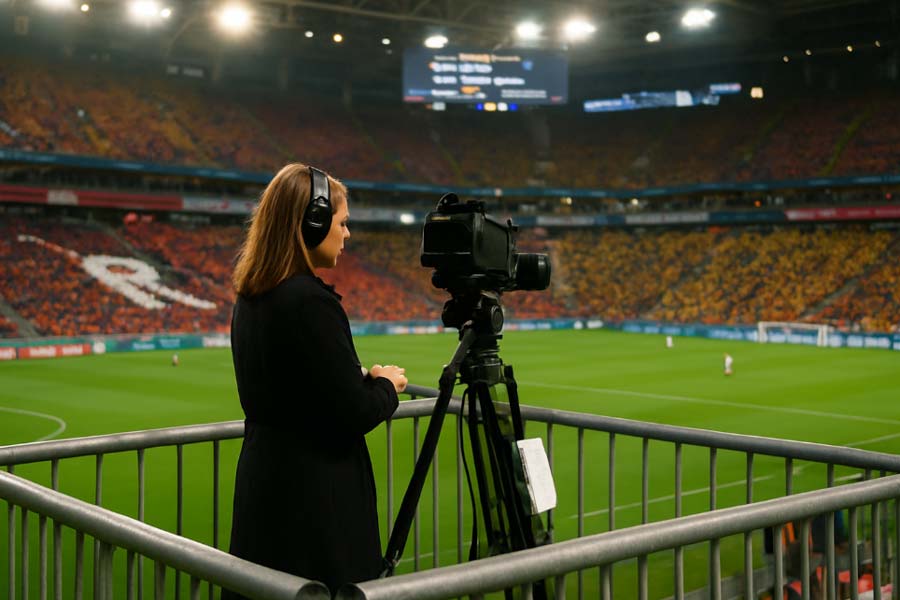

From Friday night football to Division I athletics: learn about the production infrastructure that separates amateur broadcasts from professional ones.
Sports broadcasting has changed dramatically in the past decade. What used to require a network production truck now happens in permanent control rooms built inside the venues themselves. High school stadiums, college arenas, and professional sports complexes are all investing in dedicated broadcast infrastructure because the demand for live content has never been higher.
But designing a control room for sports production involves challenges that are distinct from a traditional broadcast studio. The environment is harsher. The timeline is tighter. The operators are often students or volunteers rather than career professionals. And the production demands peak and drop on an event-driven schedule rather than a daily one.
This guide covers what makes sports venue control rooms different and what to get right the first time.
The Core Difference: Event-Driven Production
A TV station control room runs daily. A sports venue control room may sit idle for days between events and then run at maximum intensity for three to four hours straight. This event-driven pattern affects every design decision.
Equipment needs to power up fast and perform reliably after sitting dormant. Operators need to get their bearings quickly because there is no warm-up show to ease into. The production workflow has to be simple enough for a rotating crew to execute consistently even when the crew changes from event to event.
This is why system design matters more in sports than almost any other application. The room itself needs to enforce good workflow rather than relying on operator memory.
Multi-Camera Production Requirements
Sports production is inherently multi-camera. Even a basic high school football broadcast typically runs 3-5 cameras. A Division I production might use 8-15 cameras including PTZ remotes, handhelds, hard cameras, and specialty positions like end zone and slash cams.
What this means for the control room:
- Switcher capacity: You need enough inputs to handle all cameras plus graphics, replay, and external feeds. Buy more inputs than you think you need because sports productions tend to grow over time.
- Multiviewer layout: The monitor wall must show every camera feed, program output, preview, graphics, replay, and clock simultaneously. In sports, the director is making split-second decisions based on what they see on the wall. Missing a feed means missing a play.
- Replay integration: Replay is non-negotiable for sports. The replay operator needs their own dedicated position with a control surface and monitors showing multiple angles. The replay server needs to ingest every camera feed and make highlights available within seconds of a play ending.
- Graphics and scoreboard: Real-time score overlays, lower thirds, sponsored graphics, and full-screen stat packages. The graphics system needs a live data connection to the scoring system so updates happen automatically.
Weather and Environment
Sports venues introduce environmental factors that indoor studios never face. Press box control rooms in outdoor stadiums deal with temperature extremes, dust, vibration from crowd noise, and sometimes limited space inside aging structures.
- Temperature: A press box control room can reach 90-100°F during summer events with all equipment running. HVAC or portable cooling is essential. Equipment rated for extended temperature ranges is preferred.
- Dust and debris: Outdoor environments introduce dust that clogs equipment ventilation. Sealed or filtered rack enclosures and regular cleaning schedules extend equipment life significantly.
- Vibration: A stadium full of fans generates vibration that can loosen cable connections over time. Locking connectors and cable strain relief at every connection point prevent intermittent failures during the worst possible moment.
- Power stability: Venue power can be unpredictable especially at older facilities. A UPS for critical systems is not optional. It protects against the momentary power dips that are common when stadium lighting or PA systems cycle on and off.
Designing for Rotating Crews
Professional broadcast facilities have dedicated operators who know the room. Sports venues often rely on a mix of full-time staff, part-time operators, students, and volunteers. The control room needs to work for all of them.
This means clear labeling on every piece of equipment and every cable. It means standardized workflows documented on laminated cards at each position. It means system presets that configure the room for different production types with a single recall. And it means training as part of the initial installation rather than an afterthought.
The measure of a good sports control room is not how it performs when the best operator is running it. It is how it performs when the backup crew steps in at the last minute.
Scaling from Small to Large
Most sports programs start small and grow. A high school might begin with a 3-camera setup and a basic switcher. A college program may start with in-house production for conference streaming and later add network-quality capabilities for national broadcasts.
The control room should be designed to scale. This means modular console furniture that can add positions. It means a routing infrastructure with spare capacity. It means choosing equipment ecosystems that offer upgrade paths rather than dead ends.
Planning for growth at the design stage costs very little. Retrofitting a room that was built too small costs a lot.
Ready to Upgrade Your Sports Venue Production?
TakeOne has designed and built control rooms for venues ranging from college stadiums to professional sports facilities. We will assess your space and build a system that matches your current needs and your future ambitions.
Or call us to talk with our team about your project.
About TakeOne Broadcast Solutions
TakeOne is a full-service broadcast video integrator and consultant that designs, builds, and supports professional video systems for sports venues, universities, churches, and broadcast facilities nationwide. From control room design through equipment integration and operator training, we handle every phase of the project.
Request a control room assessment or call 1-877-818-2531 to discuss your project.