
Specialized Control Room Solutions for Sports & Live Events
Sports & Live Event Control Rooms Built for Flawless Live Production
The Unique Demands of Live Sports Production
Why Sports Control Rooms Are Different
The Four Critical Challenges

Zero-Tolerance Performance
A single minute of downtime during a championship game can cost you dearly in broadcast revenue, sponsor obligations, and viewer trust. Your systems must work perfectly, every game.

Split-Second Coordination
Directors call shots in real-time. Technical directors execute transitions instantly. Replay operators capture and deliver highlights within seconds. There’s no time for troubleshooting when the game is live.

Multi-System Integration
Modern sports venues demand seamless coordination between broadcast production, in-venue displays (jumbotrons, scoreboards, ribbon boards), streaming platforms, social media distribution, and often multiple simultaneous broadcasts.

High-Pressure Environment
Operators maintain intense focus for 2-4 hours straight, making split-second decisions under pressure. Your control room must support their performance, not add to their stress.
Essential Sports Control Room Capabilities
What Separates Good Control Rooms from Great Ones?
Multi-Camera Production Excellence
Sports coverage demands 8-30+ cameras operating simultaneously with instant source selection and intuitive switching.
What You Need:
- Large-format multi-viewer displays (65″+) showing all camera feeds clearly
- Professional production switchers with 24-48+ inputs
- Integrated camera control and tally systems
- Frame-accurate switching for replay analysis
- Clear monitoring visible to all operators
Why It Matters: Multi-camera coordination is the foundation of professional sports coverage. Operators need instant awareness of all sources without head-turning or confusion.
Instant Replay & Highlight Systems
Modern sports demand immediate multi-angle replays, slow-motion analysis, and rapid highlight generation for social media and broadcast distribution.
What You Need:
- High-speed replay servers recording 8-16+ angles simultaneously
- Frame-accurate playback and slow-motion control
- Multiple replay operator positions for complex events
- Automated clip generation and social media distribution
- High-capacity storage for 4K/8K content
Why It Matters: Fans expect to see critical plays from multiple angles within seconds. Social media demands immediate highlights. Your replay system must deliver reliably, every game.
Scoreboard & Display Integration
Your control room seamlessly manages all in-venue displays—scoreboards, ribbon boards, fascia displays—coordinating broadcast content, statistics, sponsor messages, and fan engagement.
What You Need:
- Unified control system for all venue displays
- Real-time statistics integration
- Sponsor content management and scheduling
- Graphics system feeding all platforms simultaneously
- Redundant control with automatic failover
Why It Matters: In-venue experience drives attendance and season ticket renewals. Your displays must operate flawlessly with broadcast-quality content while maintaining independence from broadcast feeds when needed.
Optimized Production Workflow
Game day requires tight coordination between director, technical director, replay operators, graphics operators, camera operators, and audio engineers.
What You Need:
- Operator positioning supporting clear sightlines and communication
- Crystal-clear intercom for all positions
- Ergonomic workstations for 2-4 hour events
- Logical signal flow minimizing complexity
- All critical controls within easy reach
Why It Matters: Layout directly impacts performance. Poor positioning causes communication breakdowns. Inadequate monitoring leads to missed shots. Uncomfortable workstations reduce focus.
Reliability & Redundancy
Live events have no backup plan. Your control room operates flawlessly through every game with backup systems ready for rare equipment failures.
What You Need:
- Backup video switcher on hot standby
- Dual power supplies and UPS protection
- Redundant network paths for IP-based systems
- Spare cameras and cables staged and ready
- Preventive maintenance programs
- Documented emergency procedures
Why It Matters: You can’t postpone the championship because of a technical failure. Our sports control rooms are engineered for zero unplanned downtime.
Technology That Delivers
IP-Based Video Infrastructure
Modern sports facilities increasingly adopt IP-based video systems for flexibility, scalability, and future-proofing.
Why IP Matters:
- Any source to any destination routing without physical re-cabling
- Easy reconfiguration for different sports and events
- Scalability from 10 to 100+ cameras on the same infrastructure
- Support for 4K, 8K, and HDR formats
- Remote production capabilities
When We Recommend IP:
- New construction or major renovations
- High camera counts (20+ cameras)
- Multi-room or campus-wide distribution
- Remote production requirements
- Future 4K/8K plans
When Traditional SDI Remains Practical:
- Smaller systems (under 12 cameras)
- Budget constraints requiring proven economy
- Simple, fixed workflows
- Existing SDI infrastructure in good condition
4K and HDR Production
Major sports increasingly broadcast in 4K with HDR. Should you invest now?
Invest in 4K/HDR if:
- Major broadcast contracts requiring 4K delivery
- Venue seats 20,000+ (prestige facility)
- New construction or major renovation planned
- National/international event hosting
- 7-10 year future-proofing desired
HD Remains Appropriate if:
- Regional or local broadcast only
- Budget constraints significant
- Current HD system recently installed
- 3-5 year planning horizon
Our Recommendation:
Build 4K-capable infrastructure even if starting with HD cameras. Network bandwidth, storage, and monitoring should support future 4K upgrade without infrastructure replacement.
Automated & Robotic Cameras
Automation reduces operational costs while maintaining or improving coverage quality.
Why Automation Matters:
- Reduce camera operator count for routine games
- Consistent, repeatable coverage of common shots
- Specialty angles impractical for human operators
- Scale production complexity to event importance
Automation Strategies:
- Full Automation (practice, training content, low-tier events)
- Computer vision tracking action automatically
- AI-driven shot selection with minimal operator intervention
Hybrid Approach (most regular season games)
- Robotic cameras on secondary angles
- Human operators on primary angles
- Director calls shots, automation executes
All-Manual (playoffs, championships, national broadcasts)
- Maximum creative control
- Every camera operator-controlled
- Automation for specialty angles only
Cloud & Remote Production
Remote production centralizes control rooms, sharing expensive equipment across multiple venues.
Advantages:
- Share equipment and talent across venues
- Reduce on-site staffing and logistics
- Lower operational costs for routine events
- Centralize expertise and resources
When It Makes Sense:
- Multi-venue organizations (conferences, leagues)
- High-volume schedules across locations
- Routine regular season coverage
- Budget efficiency through shared resources
Requirements:
- Dedicated fiber or high-capacity internet (1-10 Gbps)
- Low-latency connections (sub-50ms)
- Redundant connectivity paths
- Central production facility with advanced capabilities
Solutions By Sport
Football & Soccer

Requirements:
10-16 cameras, fast-paced switching, high-speed replay, tight scoreboard integration
Specialized Features
Multiple basket/goal cameras, glass-mounted cameras (hockey), overhead tracking
Typical Investment
$500,000-$1,500,000
Basketball & Hockey

Requirements:
12-20+ cameras, extensive replay, weather resistance (outdoor), complex graphics
Specialized Features
Goal-line cameras, overhead cable cameras (skycam), sideline carts, telestrator analysis
Typical Investment
$750,000-$2,500,000
Baseball

Requirements:
12-20+ cameras, extensive replay, weather resistance (outdoor), complex graphics
Specialized Features
Goal-line cameras, overhead cable cameras (skycam), sideline carts, telestrator analysis
Typical Investment
$750,000-$2,500,000
Multi-Purpose Arenas
Requirements:
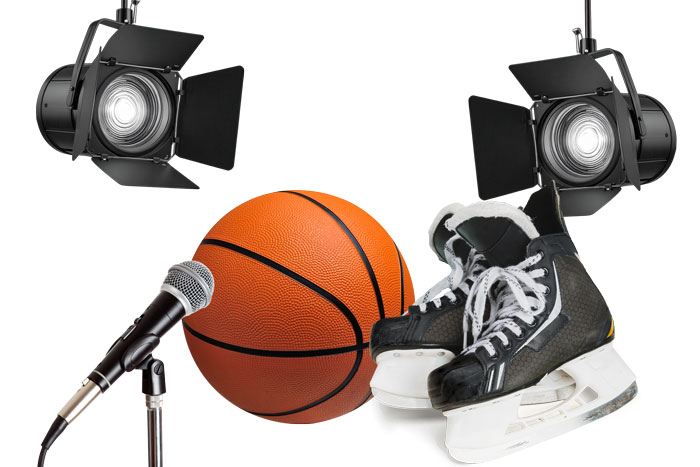
Maximum flexibility for basketball, hockey, concerts, family shows; preset-based operation
Specialized Features
Reconfigurable mounting, flexible graphics templates, scene-based automation
Typical Investment
$600,000-$2,500,000
Budget Planning
Investment Ranges by Venue Type
Small College / High School (Basic Coverage)
4-8 cameras, simple production,
basic streaming
Investment: $50,000-$250,000
Mid-Size College / Regional Venue
8-12 cameras, multi-operator, professional quality, replay capability
Investment: $250,000-$1,000,000
Division I / Professional (Broadcast Quality)
12-20 cameras, full production, comprehensive replay and graphics, broadcast TV
Investment: $1,000,000-$3,500,000
Premier / Championship Venues
20-40+ cameras, multiple production units, 4K/HDR, international standards
Investment: $3,500,000-$10,000,000+
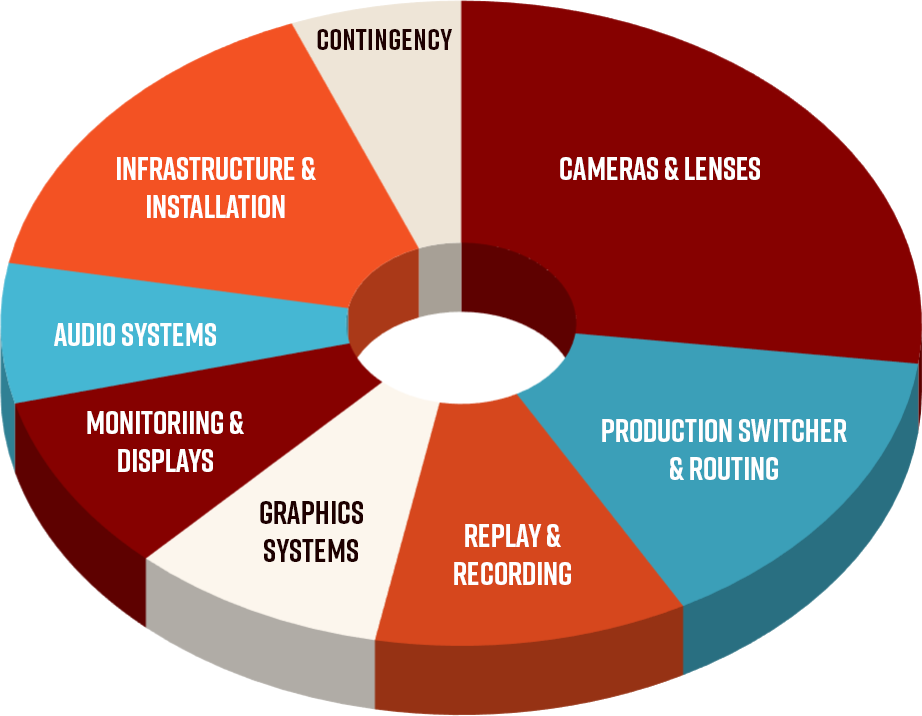
Where Your Budget Goes
- Cameras & Lenses: 25-35%
- Production Switcher & Routing: 15-20%
- Replay & Recording: 10-15%
- Graphics Systems: 8-12%
- Monitoring & Displays: 8-12%
- Audio Systems: 6-10%
- Infrastructure & Installation: 15-25%
- Contingency: 5-10%
Budget Optimization Strategies
Phase Your Investment
Spread implementation over 2-4 years, starting with core capabilities and adding enhancements as revenue grows.
Prioritize Infrastructure
Cable plant, power, and network infrastructure last 10-15 years. Equipment lasts 5-7 years. Build robust infrastructure supporting future equipment upgrades.
Strategic Equipment Selection
Premium investment in frequently-used equipment. Economy options for rarely-used components.
Automation Where It Pays
Reduce ongoing operational costs through strategic automation of secondary cameras and routine tasks.
Case Study
Fox Sports / Truist Park Project
In 2017, the Atlanta Braves transitioned to their new home, originally Suntrust Park, now Truist Park. TakeOne, in collaboration with Fox Sports and Panasonic, installed advanced PTZ (Pan-Tilt-Zoom) remote cameras throughout the ballpark.
These permanent cameras serve both in-house productions and network television broadcasts, offering wide scenic views, dedicated announcer coverage, and unique bullpen perspectives. The project featured the integration of Panasonic’s latest weatherproof PTZ technology and a specialized box camera with a large FUJINON lens, mounted atop the Comcast Regional Headquarters and connected via fiber optic cable.
TakeOne’s team, comprised of former sports and live production technicians, delivered a robust and innovative broadcast infrastructure perfect for large venues like Truist Park.

FOcused on you
Why TakeOne.TV
Sports Broadcast Expertise
25+ Sports Venues Served
We’ve designed control rooms for professional teams, Division I programs, Olympic venues, and championship facilities across every major sport.
Zero Missed Games
Our sports control rooms are engineered for reliable uptime. Our systems are built to be solid and robust.
Sports-Specific Understanding
Unlike general AV integrators, we understand sports production workflows, camera positioning, replay requirements, and the unique pressures of live sports.

Complete Design-Build Capability
Single Accountability
We design and build your control room, eliminating coordination gaps between designer and builder. One team, one responsibility, one successful outcome.
Real-World Experience
Our designs are informed by hundreds of successful installations. We know what works because we’ve built it and seen it perform through thousands of live events.
Ongoing Support
We remain your partner long after installation, providing training, maintenance, upgrades, and emergency support.

Proven Methodology
Workflow-First Design
We start by understanding your specific sports, events, and operational requirements—then select technology supporting those workflows.
Budget Transparency
Clear, itemized estimates with no hidden costs. We help you understand trade-offs and make informed decisions.
Timeline Reliability
Sports venues have hard deadlines (season start dates). We plan meticulously and execute on schedule.
FAQs
How long does a sports control room build take?
Typical projects: 12-24 weeks from design approval to commissioning. We coordinate carefully to complete during off-season windows, ensuring readiness before your season begins.
Can you work within our existing facility?
Yes. We regularly retrofit control rooms in occupied facilities, working around event schedules and minimizing disruption to ongoing operations.
What if our needs change or we want to expand?
We design with 20-30% growth capacity built into infrastructure. Future camera additions, technology upgrades, or capability expansions happen without system replacement.
Do you provide operator training?
Comprehensive training is included with every installation. We train your operators, technical staff, and backup personnel, ensuring everyone is confident and competent before your first game.
What about ongoing support and maintenance?
We offer maintenance agreements including preventive maintenance, priority support, spare equipment programs, and remote system monitoring. Many clients also engage us for seasonal tune-ups before each season.
Comprehensive training is included with every installation. We train your operators, technical staff, and backup personnel, ensuring everyone is confident and competent before your first game.
Can you integrate with our existing cameras or equipment?
Absolutely. We assess existing equipment and integrate compatible systems into new designs, maximizing your investment while upgrading where necessary.
Ready to Build a Championship-Caliber Control Room?
Schedule a consultation with our sports broadcast specialists. We'll discuss your venue, review your requirements, and show you what's possible.